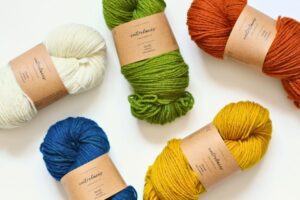

For most farmers we work with, it is the first time their wool has been transformed instead of simply being thrown away. Because their wool was considered to be agricultural waste, no special attention was taken to keep the fleeces clean.
While we collectively transition to practices that treat wool as a priority, please bear with us and the little bits of hay you find in your yarns! Think of it as a reminder that the sheep that grew your wool really liked to roll around in their food (and eat the hay off each other’s backs)
In short, no
Adding nylon to wool may make your overall fabric last longer, but not your wool.
Nylon was originally added to fine wools like merino to ensure that over time – as these soft (but weak) woolen fibers wear away in the wash and as you walk – the nylon will hold up to the wear and tear, be the last thing to break down, and keep your fabric together.
This means that after all your fine wool has worn away, you will simply have a thin nylon sock. That’s what gives synthetic blend garments that “thread bare” look. No more natural threads left, only synthetic.
If you want to learn more about the principles that make our sock yarn work, see A Synthetic-Free Sock.
Yes!
Wool itself is a hypoallergenic fiber.
This said, the pollen particles and microscopic bits of hay that could be found in even the cleanest wool are not!
Make sure to thoroughly wash your garments (following care recommendations) if they feel itchy or you feel sneezy
It’s important to choose the correct wool for the correct project. If you’re knitting a cowl and know you have a sensitive neck, choose a softer wool like the Rideau Arcott and avoid coarser wools like the Dorset.
For sweaters, we always recommend wearing undershirts and to never have the wool directly against a large portion of your skin. This creates a barrier between your skin and the wool, reducing the amount you need to wash the garment AND reducing itchiness.
It’s a win win!
Some wools felt more easily than others. In general, the finer the fiber, the more risk it has of felting.
Our stronger wools do not felt as easily due to the properties of the fiber.
Coarser fiber = Less breakage = less risk of felting.
This said, all wools have the ability to felt, it just takes more effort (like, for example, putting them through needle felting or wet felting) to felt some types over others.
If you want to make sure your wool lasts as long as possible and stays soft, we recommend using a pH neutral, wool-specific soap like:
If not, you can use any laundry detergent, with the knowledge that these alkaline soaps break down the wool fibers faster, potentially making your wool feel more brittle and itchy over time.
Once the dyes are set, hot water can break the bonds holding the dye to the fiber, causing the color to run.
When washing, use cool or room temperature water to ensure that the dyes stay properly fixed to the yarn.
I am a farmer who has sheep. How do I know if my wool can be turned into textiles?
To start, please read this article to self-evaluate your fleeces.
If you are uncertain, contact olivia@entrelaces.ca for evaluation, advice, or to chat about your possibilities!
I think my wool is textile-worthy and want to work with you. How do I proceed?
Contact olivia@entrelaces.ca for a free on-site evaluation.
If your fleeces are from a breed that we are looking for, we will check for:
If your fiber is accepted, an offer will be made and the fleeces will be purchased
Get a sneak peak behind the scenes into what we do and who we work with, bringing transparency into our world of textiles!

